Showing posts with label Peru. Show all posts

Thursday, February 3, 2011

Just some interesting facts about Peru

Peru is the third largest country in South America.
Peru is the second largest producer of cocaine...hmmmm


There are thousands of different varieties of potatoes.


The national culinary dish is: cuy...I wonder what that is..
a hint: it starts with guinea..and ends with pig..


Machu Pichu was voted one of the New Seven Wonders of the World in 2007!

Tuesday, February 1, 2011

Immigration in Peru

Migration and Immigration in Peru
Peru is the number one mineral exporter in the world. Therefore, many mine workers are needed because Peru has been introducing new mining technologies and is on the lookout for more mining opportunities. For this, more laborers are necessary. This has caused the migration within Peru to change. The most popular mining places are in the Andes. The change in mining and its new opportunities is due to Peru becoming more liberal and therefore more attractive to international investments during the last decades. In 2000, 2/3 of the entire production of Peru was mining.
During the first part of the 20th century, the Peruvian population mostly still lived in rural areas. This has changed and nowadays more than 70% of the entire population lives in urban areas in order to be closer to work. Also, more than 1/3 of the population alone lives in Lima, the capital of Peru, where more than 40% of the inhabitants are immigrants.
Another aspect of migration is that some migration is only temporary where male and female household members move to the larger cities, live with relatives, make money, and send this money back to their families in the rural areas. This behavior reflects on the family back at home. Meaning they have more disposable income at hand in order to better their own life, as well as wanting to contribute as much as the family member who moved away. Households where a family member is living somewhere else can actually focus on other things now (e.g. health and education) instead of just wondering how to feed themselves. Some migration is still permanent though. This occurs when rural families send their children to Lima in order for them to get an education. Usually, these children decide that they do not want to return to the rural areas and stay in the bigger cities.
Due to the highly technological aspect of mining (machines, managemet etc), international immigration is very common as well. These international immigrants display the high foreign interest in Peruvians mining business. Usually, these immigrants form their own kind of settlement and do not live with the average Peruvians. This leads to increasing land prices, as well as new housing types.
In 2010, Peru had a population of 29.5 million of which 0.1% were immigrants. Within the last 10 years, about 2 Million people migrated to other countries; more than half of these migrants were women).

The Status of Women in Peru

Women in Peru´s Society

What exactly is the status of the about 19 million women in Peru? Under law, they are considered equal to men but sexual and racial discrimination still occurs and domestic violence is widespread. The numbers of harassment, violence, rape, etc are increasing year by year.

Following an example of the workforce: Peru is a large exporter of asparagus which is a short working season but very intense. Women usually only get short term contracts and have to work up to 18 hours a day. Short term contracts mean: no vacation, no health insurance, no social security. Also, women usually have no chance of advancing in this field and are stuck with these manual labor jobs. The supervisors in that industry are all men. Not surprising is also that women only make minimum wage. If the supervisors find out that a woman is pregnant, she usually gets fired immediately because law would require for her to be put into a less dangerous position which would lead to her not being able to work as hard. These laws have been passed and do exist. However, they are not really enforced; therefore of not much help to the women in the workforce. What this shows is that to the outside, Peru does a lot to protect women but on the inside it is not really enforced. Women in the workforce are just a quota that needs to be filled in order to look good. Especially single mothers are vulnerable to this kind of work because they have no other opportunities, since they do not receive any kind of other training to further their careers).

However, this is only one side of the story. Well educated women play a very important role in Peru´s business and social life. If women get the education they need and can access the opportunities that do exist, they are capable to be very valuable parts to society. The key is education and equality. Successful Peruvian women know that Peru needs role models that are willing to step up to the plate and do what it takes to ensure that other females get the same chances they had. One organization that fights for equality and opportunities for women, and works towards the achievement of these goals is AMUBA.

For more information, check out this article:

http://findarticles.com/p/articles/mi_go2043/is_5_62/ai_n55386164/?tag=content;col1


Cranial Deformation, an interesting tradition

This practice is, just like tatoos and piercings, a way of making oneself look different than others.

Historically, this practice has been around since the beginning of time and has happend all over the world within all kinds of different cultures. However, in South America the neonatal cranial deformation was mostly popular in the Andes region, and widely practiced by the ancient Peruvian people, dating back to 6,000-7,000 years BC. There were three different methods used in order to modify the shape of the newborn skull. One method was to compress the head (front and back) by putting it in boards, or pads, which were fastened with bandages. Another way of doing it was to tightly wrap the head with a binding. The third method introduces a cradle-board.


What was the reason for this practice though? The reasons varied from culture to culture but mostly, just like tattoos and piercings nowadays, the practice was used to make someone look different than the rest of society or to distinguish between groups in society (e.g. slaves, classes, castes, nobility, ruling classes, etc.). In certain regions it was used to show the social status of a person, meaning the higher classes had a different head shape than the lower classes in society. In some cultures, this practice was only performed on men, in other cultures it was only performed on women. However, scientific evidence has shown that this practice has no effect on the brain functions in general. Interesting is that the practice of deforming skulls is a lot older than piercings and tattoos, and it is still performed in some cultures up to this day.

I could not exactly find out where this practice has its origin though. Some say it is a religious practice, other articles I have found even argued that the practice came about after aliens visited these cultures and the people wanted to look like them .


History, Government, and Economics


Peru is a presidential republic in the western part of South America, famous for the lost city of the Incas, Macchu Picchu. During the 16th century, Peru became a European colony and finally, after almost 300 years of Spanish colonial reign, the country became independent in 1824.

Peru’s recent history has experienced ups and downs, especially politically. During the 1990s, the president of Peru was Alberto Fujimori.

His dictatorial style and human rights violations (state murder, torture) that took part during a so called “dirty war” lead to the crumbling of the Peruvian democracy. After Fujimori was reelected in 2000, the news came out that his security chief bribed someone from the opposition. Since Fujimori had openly spoken out against bribing (obviously he was not opposed to it after all), he resigned as president and fled to Japan. In 2007, he was found guilty and was sentenced to 6 years in prison. Although Fujimori as a leader is not necessarily a role model, his reforms lead to economic growth during the 1990s. In 2006, Alan Garcia became the president of Peru and all expectations were, and still are, on him to keep up the economic and structural reforms that have been leading to Peru’s growth during the past years.

Peru´s economy depends strongly on the export of coffee and copper, with Peru being the second largest producer of copper and zinc in the world (Political Country Forecast, 2006). During the 1990s, Peru endured political instability, as well as internal unrest (guerilla wars). Therefore, the economic growth decreased and Peru experienced financial shortages. However, with the beginning of the new century, the economy (meaning the GDP) picked back up and Peru experienced a GDP growth of about 7.4%.

During the 1980-1990s, Peru went through a long phase of hyperinflation. Fujimori was able to decrease three digit inflation rates to rates with only one digit, as shown below.


The inflation rate has decreased from its highest percentage of about 750% in 1990 to about 2% in 2006. Clearly, these ups and downs are a reflection of Peru’s inner turmoil during that time. At the moment, Peru´s government is relatively stable; therefore the country itself is able to grow and Peru experiences more growth than any other country in Latin America.

A future prediction:
The internal growth of Peru’s economy is looking up. The unemployment rate is at a low right now, meaning the population has more disposable income at hand which will lead to economic growth (car sales have already started to go up, as well as a steady increase in the cell phone market is observed). It is indicated that the GDP will continue to grow but due to its geographic location, Peru’s economy is intertwined with the economy of Asian countries, especially China. One challenge that Peru will face is due to the heavy reliance on its commodities like coffee and copper. In the future it is to be expected that market prices for these will decrease, therefore not leaving a whole lot of room for profits. A decrease in the need of commodities, especially by Asian countries, will lead to lower exports.

Overall, Peru has undergone many political and economical changes since its independence from Spain and more is still to come.

Tuesday, January 25, 2011

What do I know about Peru?


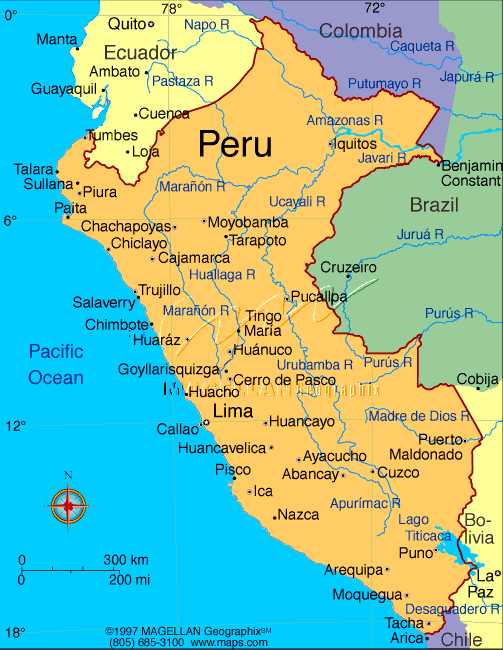
Truthfully, not a whole lot...It is a country in South America, on the western side, bordering Bolivia. The main language is Spanish. The Andes go through Peru. The Incas used to live here. Peru is the biggest producer of fish oil (don´t ask why I know that), and they eat Alpaca.


The picture pretty much summed up my idea of this country....

However, during the course of my study of this country, I have learned a whole lot more about it than this which I will talk about in later posts.